Prefab Homes in California: Complete Guide to Factory-Built Housing Options in 2026

Introduction
Prefab homes in California offer homeowners a faster, more affordable path to new construction in a state where the average home price sits at $655,200. Whether you're considering a manufactured home, a modular home, or an innovative site-built alternative, factory-influenced construction methods are reshaping how Californians add housing to their property.
This guide covers the full spectrum of prefab housing options available in California today-from HUD-code manufactured homes and code-compliant modular homes to site-built solutions like Type Five, which builds on site with conventional wood framing and uses a modular design system to keep timelines and costs predictable without giving up the customization of traditional construction. It's written for California homeowners evaluating ADU projects, backyard homes, or full-scale residential builds who want to understand what each approach actually costs, how long it takes, and which option fits their site conditions and budget.
Prefab homes are an efficient housing solution in California, with manufactured homes starting at $90 to $160 per square foot, modular homes offering greater customization at a higher price point, and site-built alternatives delivering prefab-competitive timelines without the transport and crane logistics that complicate many California lots.
By the end of this guide, you'll understand:
- The real differences between manufactured, modular, and site-built options
- How California's housing regulations, climate risks, and ADU laws affect your project
- Accurate cost, process and timeline comparisons across all three construction types
- Common challenges California buyers face and how to solve them
- How to evaluate whether a prefab or site-built approach best serves your property and what expect with each type
Understanding Prefab Homes in California
A prefab home, short for prefabricated home, is any residential structure where major components are constructed off-site in a factory or controlled environment before being transported to the building site for final installation. In California, where site-built single-family home builds routinely takes 12–18 months and costs escalate rapidly due to labor shortages and material prices, prefab offers a compelling alternative. Prefabricated homes can be built 60% faster than traditional homes, and they typically cost 10–25% less than traditional construction.
Prefab solutions matter for California homeowners because the state's housing shortage is acute, construction costs vary significantly in metropolitan areas like San Francisco, and regulatory changes, particularly around accessory dwelling units, have opened new opportunities. Prefabricated homes are constructed in controlled environments to reduce waste, and the manufacturing process leads to more predictable budgets, addressing two of the biggest pain points in residential housing builds.
Manufactured Homes
Manufactured homes are built to the federal HUD code (Title 24 CFR Part 3280) in a factory, transported to the site on a steel chassis, and arrive with fully finished interiors. In California, manufactured homes are regulated by HUD at the federal level and by the California Department of Housing and Community Development (HCD) under the state's Manufactured Housing Act of 1980.
The average starting price for modular homes is $90 to $160 per square foot for the structure, though manufactured homes generally fall at the lower end of this range. An 1,800 square foot prefab home costs about $162,000 in California for the structure itself, before accounting for site work, foundation, and utility hookups. Manufactured homes are typically single-story structures and are often more affordable than modular homes. The timeline from order to move-in runs approximately 3–6 months, making this the fastest and most budget-friendly prefab option.
The trade-offs are real: manufactured homes may be harder to finance through conventional mortgages (often requiring chattel loans), can depreciate unless permanently affixed to a foundation, and face zoning restrictions in some single-family neighborhoods. Design flexibility is limited compared to other options.
Modular Homes
Modular homes are built to state and local building codes-not HUD code-assembled as volumetric modules in a factory, then transported and placed on a permanent foundation. Once installed, they're treated as real property, just like any site-built house. Modular homes can be multi-story structures and offer significantly more customization in floor plans, layouts, facades, and interior finishes than manufactured homes.
California modular homes focus on energy efficiency and minimal maintenance, and they must comply with local building codes including the California Building Code (CBC). Many prefab homes are solar-ready and engineered for seismic resilience, which matters enormously in earthquake-prone California. The factory build portion typically takes 7–9 weeks, with total project timelines of 4–7 months for straightforward sites, though complex lots can push that to an average of 8–12 months.
The installed cost in California often ranges $120–$230 per square foot for standard 2–3 bedroom homes, including site work, permits, foundation, delivery, and crane placement. For a 2,000 square foot home, expect totals of $240,000–$460,000 excluding land.
Site-Built Alternatives
Not every homeowner searching for prefab solutions needs a factory-built unit. Companies like Type Five have developed a hybrid approach that delivers prefab-competitive timelines and cost predictability through a traditional build process. Type Five builds on-site using standard wood framing and streamlines the process with a software-driven design configurator, standardized components, pre-selected finish packages, and a streamlined process that eliminates the months of decision-making that typically slow down custom builds.
Start designing your home on their online home designer and see all-in quotes immediately. Pricing estimates cover design, engineering, permitting, finishes, appliances and construction. While the per-square-foot cost is higher than a large modular home, the all-in pricing eliminates the hidden costs (transport, crane access, street closures, oversized load permits) that frequently surprise modular buyers in dense California neighborhoods.
This hybrid model is particularly relevant for people who want the speed and budget certainty of prefab without the logistical headache, a distinction that becomes critical when we look at California's unique housing regulatory and geographic landscape.
California-Specific Considerations for Prefab Homes
California's building environment presents challenges that don't exist in most other states. Understanding these factors before choosing a construction method can save owners months of delays and thousands in unexpected costs.
Regulatory Environment
California has strict, localized zoning laws for prefab units, and the regulatory picture differs substantially depending on whether you're building a manufactured home, modular home, or site-built structure. Manufactured homes fall under HUD federal standards plus HCD state regulations. Modular homes must pass plan checks and inspections through local jurisdictions under the CBC. Site-built homes and ADUs follow the same local code path as any conventional build.
For accessory dwelling unit projects, the regulatory landscape has shifted dramatically in property owners' favor. State ADU law now requires local governments to allow at least one detached ADU by right on lots zoned for single-family residential. Parking requirements have been relaxed (eliminated for ADUs within half a mile of transit), setbacks limited to four feet for detached units, and housing design review minimized. State law often mandates that jurisdictions respond within 60 days of a completed ADU application. Permits are acquired before breaking ground, and this permitting phase typically runs 2–4 months for new ADU builds.
Accessory Dwelling Units serve multiple purposes: rental income, aging-in-place housing, home offices, guest quarters. The regulatory easing has made them one of the most practical applications for both prefab and site-built solutions.
Climate and Geographic Factors
California's geography imposes requirements that affect every building type. In seismic zones, modular homes must be engineered to resist seismic loads, and manufactured homes require specific foundation anchoring when permanently installed. Many prefab units use eco-friendly materials and offer high energy efficiency, but they must also meet California's Title 24 energy standards, which are among the strictest in the nation.
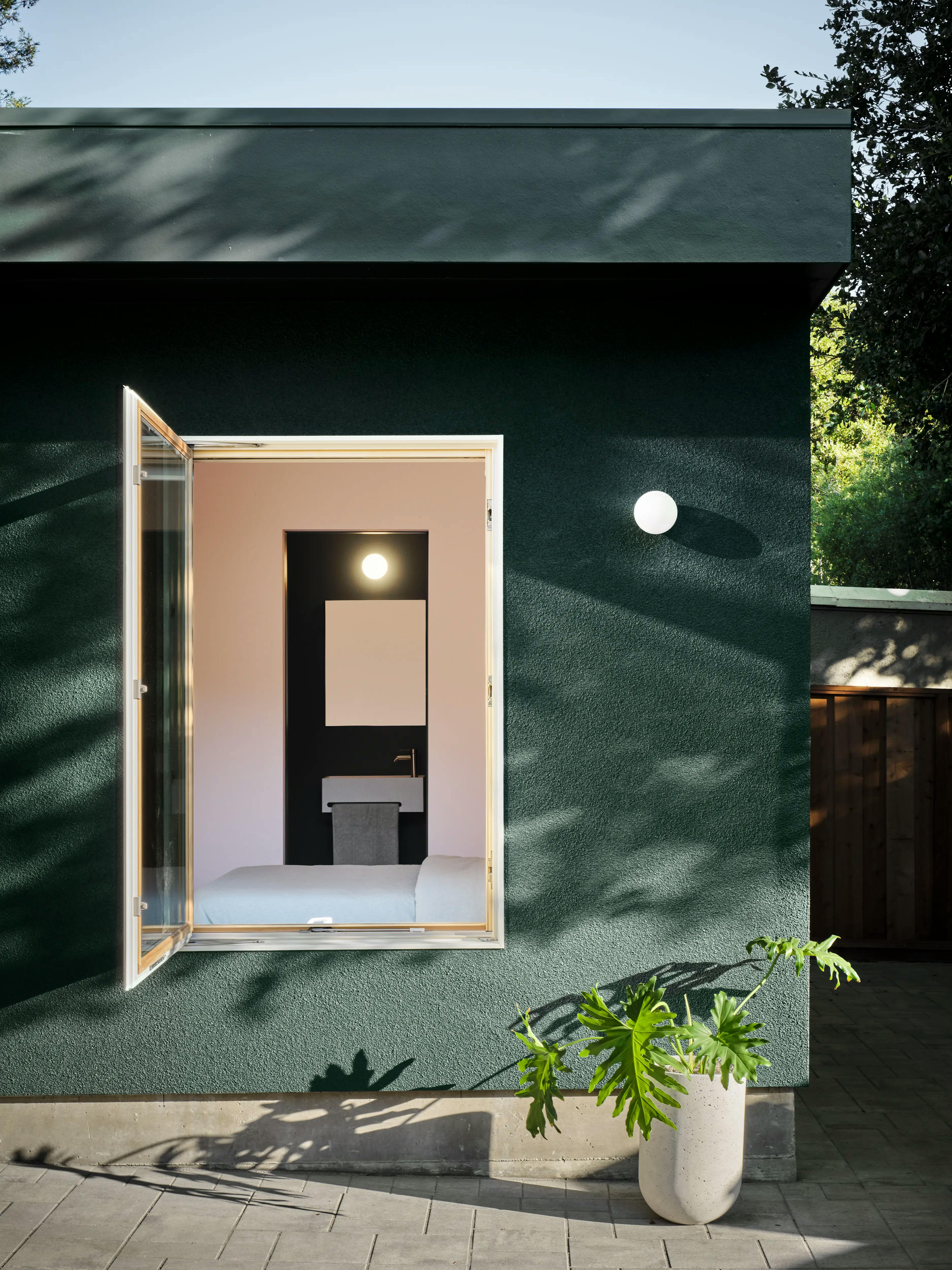
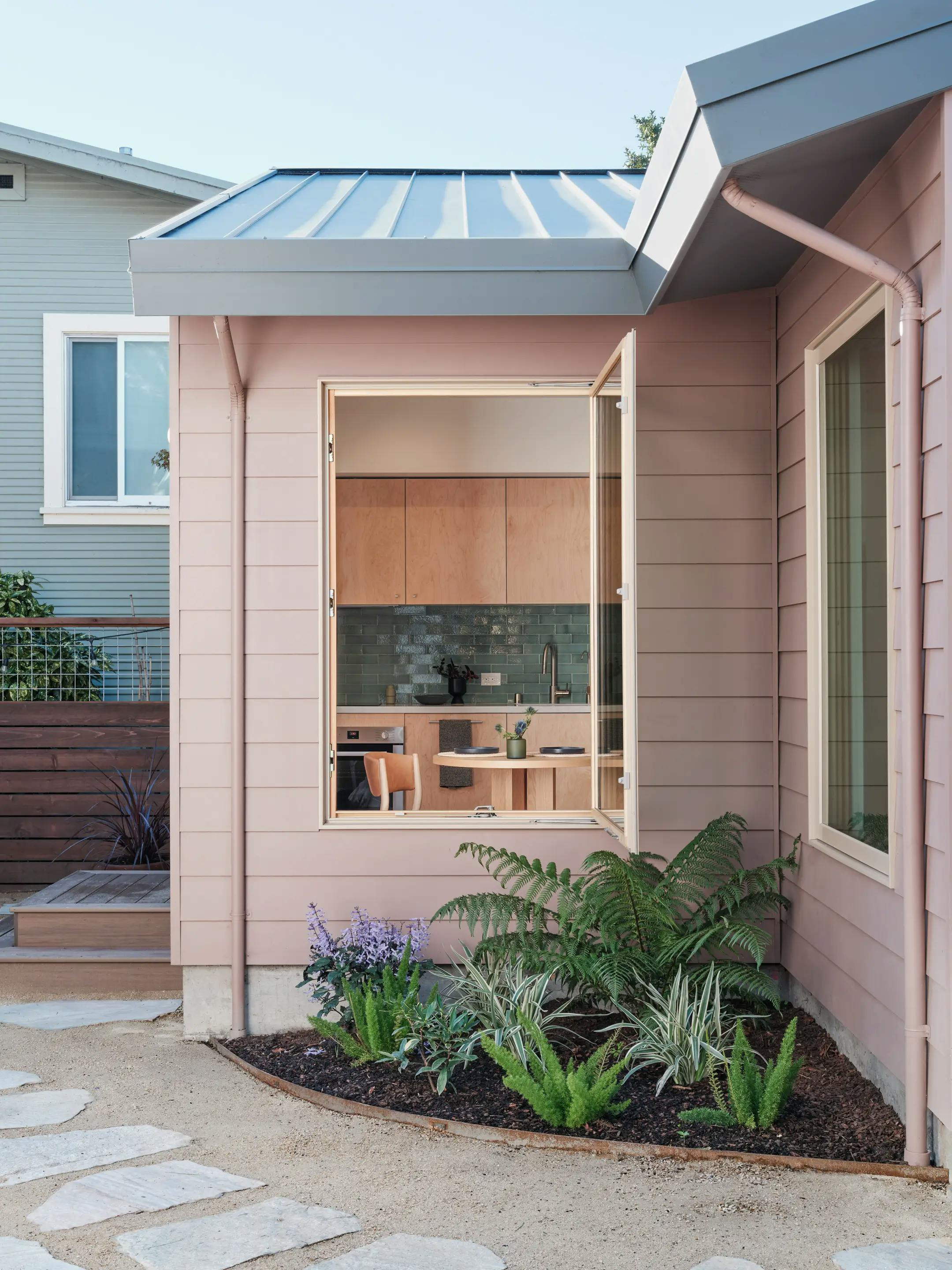
In wildland-urban interface (WUI) zones, fire-resistant building is mandatory. This means fire-resistant siding, Class A roofing, tempered glass, and defensible space requirements regardless of whether the home is manufactured, modular, or site-built. Type Five's Caldwell ADU project in Oakland is a fire-resistant 400 sq ft, 1-bed/1-bath ADU in a WUI zone that demonstrates how experience-driven, thoughtful design can integrate fire-resistant materials while accommodating the access constraints (overhead power lines, narrow lots, steep slopes) that make crane delivery of modular units impractical.
Prefab units can be customized to fit specific site conditions, but the feasibility of modular home delivery varies enormously. Coastal locations demand moisture protection and insulation specifications. Hillside lots may require extensive foundation engineering and geotechnical reports. Each of these factors affects both cost and construction method selection.
Market Conditions
Regional land costs dramatically affect total investment. Bay Area lots carry premium values, tight dimensions, high permit fees, and expensive labor markets. Southern California presents similar dynamics. More rural areas offer lower land costs but increase transportation expenses for modular units shipped from distant factories.
Construction costs vary significantly in metropolitan areas like San Francisco, where labor alone can add 20–30% to project totals compared to inland markets. These market conditions often make site-built hybrid approaches more cost-competitive than modular in dense urban settings, since they eliminate the crane access, street closure permits, and oversized load logistics that inflate modular delivery costs in tight neighborhoods.

How to Evaluate and Select Your ADU Company
Choosing an ADU company should feel like a structured evaluation, not a sales conversation. The right builder should be able to explain the process, identify site risks, discuss permits, show relevant work, and give honest guidance about whether your budget matches your goals.
Do not look only for the lowest price per sq ft. Look for a professional expert team that can maximize value, communicate clearly, and create a realistic path from concept to completion. A great experience usually comes from the quality of the process as much as the quality of the finished house.
Initial Consultation Process
Top-tier companies use the first consultation to test feasibility, not just sell the project. Expect a serious conversation about property constraints, city rules, family goals, investment return, schedule, design preferences, and budget.
- Initial site assessment: The builder reviews the property, access, setbacks, utilities, slope, existing structures, and likely site preparation issues.
- Design discussion: The team clarifies whether you need a rental unit, guest space, home office, granny flats for family members, or a flexible studio for changing lifestyle needs.
- Permitting roadmap review: The builder explains permits, pre approved plans, site-specific plan submission, city review expectations, and possible correction cycles.
- Pricing presentation: The company provides itemized pricing, separates hard and soft costs, identifies allowances, and explains where the project may require contingencies.
Construction timelines can be predictable when the scope is. However, timelines become less predictable when homeowners change finishes, cities request revisions, utilities require upgrades, or the site reveals conditions that were not visible during early planning.
Company Credentials Comparison
Before choosing an ADU builder, verify credentials and proof of performance. A polished website or social media post is not enough.
The strongest credentials are practical, not decorative. A builder should be able to show how the team handled permitting, engineering, inspection, subcontractors, finish details, and client communication on projects similar to yours. Type Five has built dozens of ADU projects across the Bay Area that demonstrate results in real backyards and neighborhoods.
Technology, Design Tools, and Prefab ADUs
Technology is not a substitute for construction expertise, but it can improve decision-making. Modern ADU firms may use design configurators, 3D renderings, digital finish selections, project management dashboards, and feasibility tools to help clients understand space, pricing, and schedule earlier, especially when they integrate design and construction under one roof. This is especially useful for homeowners comparing prefab, semi-custom, and fully custom models
Type Five uses a software-enabled design process that allows anyone to design their dream adu on their website. The online design tool helps show how a 500 sq ft studio differs from a 750 SF two-bedroom in layout as well as construction cost estimates.
The best tools connect design choices to real constraints. A roofline, window package, kitchen layout, or foundation change should not be treated as a simple aesthetic option if it affects engineering, Title 24 compliance, permits, construction time, or budget.
Common Challenges and Solutions
Most ADU problems begin before construction starts. Unclear scope, weak permitting strategy, poor communication, and unrealistic schedules can turn a promising project into a stressful one.
A good builder will not promise that every risk can be eliminated. Instead, the company should identify risks early, document assumptions, communicate regularly, and adjust professionally when site or city requirements change.
Unclear Pricing and Hidden Costs
The solution is to demand an itemized estimate before signing. The proposal should explain design fees, engineering, permits, utility work, foundation assumptions, site preparation, finishes, appliances, landscaping repair, and any exclusions.
Ask how change orders are priced and approved. Transparent pricing should tell you when extra money may be required and who decides before the work proceeds.
Be cautious when a contractor gives a low square foot estimate without explaining whether it includes soft costs, utility upgrades, soil reports, Title 24 work, or city fees. In Oakland, those details can change the value of the proposal more than the headline number.
Poor Communication During Construction
The solution is to establish communication protocols upfront. Ask who your day-to-day contact will be, how often updates are sent, whether meetings are weekly or bi-weekly, and how the company documents decisions.
Clients should know whether the builder uses a project management platform, shared schedule, photo updates, or written milestone reports. Good communication is not just friendly service; it protects the project from missed details and disputes.
If you are building for family, rental income, or a future investment sale, communication matters because delays can affect move-in plans, lease timing, financing, and household routines.
Permitting Delays and Complications
The solution is to vet the company’s permit success rate in your municipality. Ask how many ADU permits the team has handled in your city, whether the builder understands local planning processes, and how the team responds to correction letters.
Permitting can be expedited with pre approved plans, but those plans are not a universal shortcut. The property still needs site-specific review, and local regulations may affect setbacks, height, fire access, utilities, parking, tree protection, or design compatibility.
A builder with strong local knowledge should be able to explain the difference between statewide California ADU rights and your city’s objective standards. That distinction is critical in communities where local rules still shape the path to approval.
Quality Control and Timeline Issues
The solution is to define quality standards, inspection milestones, and schedule assumptions before construction begins. The contract should clarify materials, finish packages, subcontractor responsibilities, payment schedule, change-order rules, and warranty process.
Prefab can help some homeowners reduce on-site construction time, but prefab is not automatically better for every site. Prefab ADUs can be completed in as little as 6 months under the right conditions, but access, slope, crane placement, utility work, and city review can affect that timeline.
Custom site-built ADUs may take longer, but they can adapt more easily to unusual lots, architectural compatibility, and specific family or rental goals. The right answer depends on your property, plans, budget, and priorities.
Prefab Process and Cost Analysis
With California's regulatory and geographic requirements in mind, the practical question becomes: what does each path actually look like from start to finish, and what will it cost?
Typical Prefab Home Process
Most prefab home projects take 6–9 months to complete, though the specific timeline depends heavily on build type and site complexity. Site preparation occurs while the home is built in the factory, which is one of the key time advantages of prefab. Construction typically finishes within 3 months after permits are finalized for standard manufactured and modular installations.
Here's the general sequence:
- Site evaluation and feasibility assessment - Survey your property for lot dimensions, slope, access, utility connections, fire zone designation, and soil conditions. This step determines which construction methods are viable for your location.
- Design selection and permitting - Choose your floor plans, finishes, and specifications. Permits are filed and reviewed by local authorities (60-day response required for ADUs under state law). Prefab homes must be prepared for utility access including electricity and water.
- Factory construction or on-site build - Manufactured and modular homes are constructed in the factory while site preparation (foundation, grading, utility runs) proceeds simultaneously. Site-built alternatives like Type Five begin construction after permits are approved, with a typical build time of about six months.
- Delivery, installation, and finishing - Modular and manufactured homes are transported and installed; inspections follow. Site-built homes complete on-site, avoiding the delivery logistics entirely.
Type Five's process follows a slightly different rhythm: design through their online configurator is instant, permitting runs 2–6 months, and the build takes roughly six months on site, aligning with their fixed-price, 10–12 month ADU timeline. They provide a fixed-price build contract after permits are approved, with real-time pricing impacts shown during the design phase so clients see how finish selections affect their budget.
Cost and Timeline Comparison
Criteria | Manufactured / Prefab Home | Modular Home | Site-Built Hybrid (Type Five) |
Cost per sq ft (all-in) | $90–$160/sq ft (structure); add 20–40% for site work | $120–$230/sq ft installed in CA | ~$667/sq ft for 300 sq ft studio (all-in); decreases for larger units |
Total cost example | ~$162,000 for 1,800 sq ft structure | $240,000–$460,000 for 2,000 sq ft (excl. land) | ~$200,000 for 300 sq ft ADU (all-in) |
Timeline | 3–6 months total | 4–7 months (up to 12 for complex sites) | 10–12 months (design through move-in) |
Customization | Limited floor plans and finishes | Moderate to high | Full customization via configurator |
Quality/code standard | Federal HUD code | State/local building codes (CBC) | State/local building codes (CBC) |
Financing | Often chattel loans; limited options | Conventional mortgage eligible | Conventional mortgage eligible |
Transport/crane required | Yes (chassis delivery) | Yes (crane + oversized loads) | No-fully built on site |
Property value impact | May depreciate | Appreciates like site-built | Appreciates like site-built |
Prefab and modular home construction minimizes damage to materials during building through the controlled factory environment. However, when comparing costs, homeowners should account for the hidden expenses that don't appear in base prices: foundation engineering ($5,000–$15,000+), utility hookups ($3,000–$10,000+), transport and crane fees for modular ($5,000–$20,000+), permit and impact fees (varies widely by city), and site grading or retaining walls for challenging terrain.
Type Five's site-built approach centers on budget predictability and an efficient, standardized design process, while avoiding the transportation and crane costs that often erode modular savings on constrained California lots.
California's average home price of $655,200 provides context for why these options attract homeowners: even at the higher end, prefab and site-built ADU solutions represent a fraction of the cost of purchasing additional property.
Common Challenges and Solutions
Every build method in California comes with friction points. Here's what to expect and how to address the most common obstacles.
Permitting Delays
Permitting is the single most unpredictable phase in any California housing project. Plan check revisions, utility coordination, and code compliance questions can stall even straightforward applications. Working with a team experienced in local jurisdictions, like Type Five, which handles end-to-end permitting, coordinates surveys, and submits permit-ready architectural drawings generated through their design system, significantly reduces delays. Their familiarity with specific cities (Oakland, for example) helps anticipate code requirements before plans are submitted.
Limited Customization with Traditional Prefab
Factory-built manufactured and modular homes often lock homeowners into predetermined layouts, window patterns, and exterior treatments. If design flexibility matters to your project, explore modular builders offering configurable modules or consider a site-built alternative with a design configurator. Type Five's online configurator lets homeowners experiment with size, shape, layout, and finishes while automatically generating the permit-ready drawings and engineering specifications-providing the customization of a fully custom home with a streamlined, standardized process, all built on site.
The Ramona project, one of Type Five's featured ADU builds in California, illustrates this advantage: a retired couple needed office and guest space, but their lot had crane access concerns that made modular delivery problematic. Type Five's site-built approach avoided those logistical constraints entirely, and the project became possible only after California's relaxed ADU regulations removed previous parking and setback barriers.
Financing Complications
Manufactured homes frequently require chattel loans with higher interest rates and shorter terms, making them harder to finance than conventional real property. Modular homes and site-built alternatives constructed on permanent foundations generally qualify for conventional, FHA, VA, and USDA financing. If financing flexibility is a priority, ensure your chosen build type results in a structure classified as real property, meaning it has a permanent foundation, compliant with state/local codes, and titled as real estate rather than personal property.
Site Preparation Costs
Site work is where budgets most often go sideways. On difficult terrain or constrained urban lots, foundation costs, grading, retaining walls, and utility runs can add 20–50% or more to the base structure cost. Prefab units that require crane placement face additional expenses for street closure permits and power line management.
The solution is a thorough site feasibility assessment early in the process. Type Five includes site inspections like soil analysis, topography assessment, setback calculations, utility location, as part of their turnkey services, with cost implications reflected in pricing before the construction contract is signed. For any construction method, budget a contingency of 10–15% above quoted site preparation costs to protect against unanticipated conditions.
Common Challenges and Solutions
California homeowners have more factory-built and prefab-competitive housing options in 2026 than at any point in the state's history. Manufactured homes offer the lowest cost entry point for straightforward sites. Modular homes deliver higher quality and customization while still cutting timelines compared to traditional construction. And efficiency-centric services like Type Five provide full design flexibility, fixed-price certainty, and prefab-competitive efficiency without the transportation, crane, and access logistics that complicate many California lots. Prefab homes address California's housing shortages and high costs across all three categories.
Take these next steps to move your project forward:
- Assess your property - Evaluate lot size, access points, slope, overhead power lines, fire zone designation, and utility locations to determine which construction types are feasible for your site
- Research your local ADU and zoning regulations - Understand your jurisdiction's setback requirements, height limits, and whether manufactured homes qualify as ADUs in your area
- Compare approaches with real all-in costs - Request fully loaded quotes including site work, foundation, permits, transport, and finishing rather than just structure costs
- Schedule consultations - Talk to at least two or three providers across different construction methods; explore Type Five's online configurator to see how a site-built ADU compares in price and timeline to factory built alternatives
For homeowners exploring related decisions, California's evolving ADU regulations continue to expand what's buildable. Sustainable building materials, processes, and passive house design principles can further improve energy efficiency and long-term value. Specialized financing products for factory-built housing are becoming more accessible as the market matures.
Additional Resources
- California HCD ADU Handbook - Official state guidelines covering ADU regulations, setback requirements, parking exemptions, and permitting timelines for all construction types
- California Building Code (CBC) requirements - Reference for modular and building code compliance, including Title 24 energy standards and WUI fire-resistance specifications
- Type Five's online configurator - Design tool for exploring ADU floor plans, finishes, and pricing with automatic cost impact visibility at www.typefive.com
- Local building department contacts - Your city's planning and building department is the definitive source for jurisdiction-specific permit fees, impact fees, and zoning restrictions
- HUD manufactured home standards - Federal requirements for manufactured homes, including construction safety standards and installation guidelines
Looking for a homebuilder?
Every homebuilding project is unique, and Type Five wants to hear about your vision. By understanding your lifestyle and budget, we help turn your dream home into a reality. Schedule a free consultation to discuss your project, and learn more about working with us.